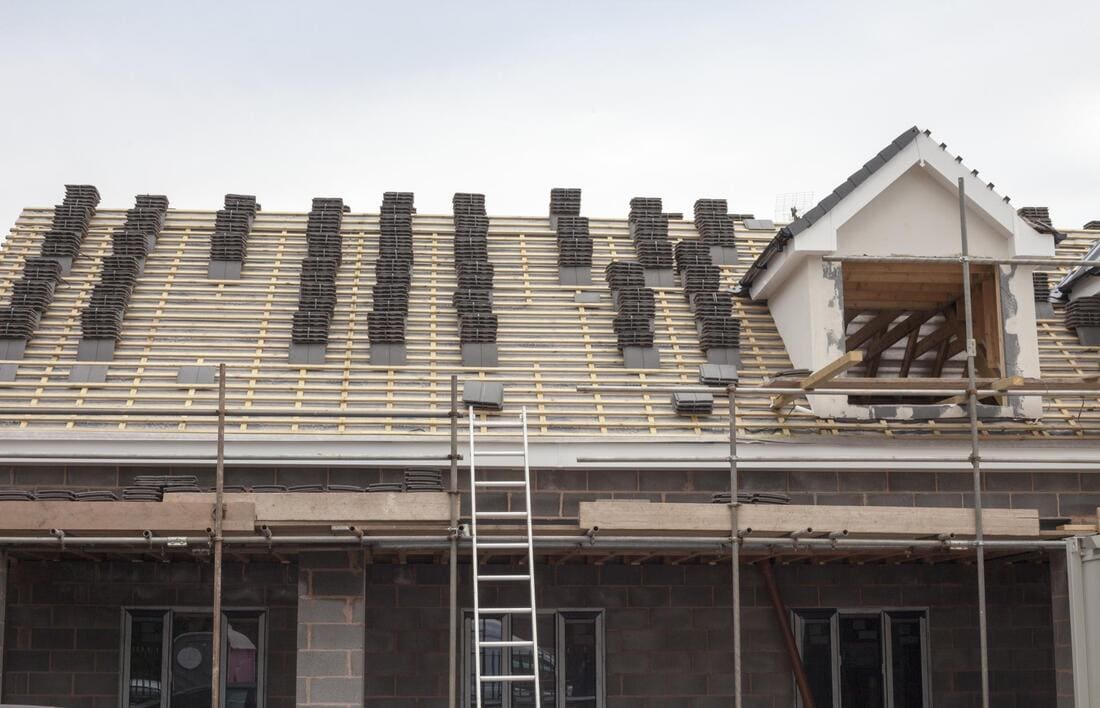
Why do Minneapolis roof repair quotes vary so much?
Pitch, height, access, snow or ice conditions, material, decking damage, roof age, and whether a leak has spread inside all change the scope.
Roof repair cost in Minneapolis depends on what the roof actually needs, not just the symptom you can see from inside. A vent boot on a low, easy roof is a different job from tracing an ice-dam leak through wet decking on a steep 1.5-story home. Call (612) 482-8462 for an inspection and a written quote tied to your roof.
Use the ranges below to test a scope, not to diagnose the problem from a price. Two brown ceiling rings can lead to very different work. One may trace to a split boot with dry decking around it. The other may begin at an ice-dammed eave, cross wet sheathing, and reach a half-story wall after soaking insulation. The contractor has to find the failure before choosing the correct tier.
| Scope | Planning range | Often includes |
|---|---|---|
| Minor repair | $300-$700 | Pipe boots, a small shingle patch, minor flashing work, or a short gutter-edge repair. |
| Moderate repair | $650-$1,600 | Leak tracing, an ice-dam leak repair, valley work, or a limited decking patch. |
| Major repair | $1,600-$4,500 | Storm-damaged sections, sheathing replacement, chimney/sidewall rebuilds, or low-slope tie-ins. |
| Emergency tarp or dry-in | $350-$900 | Temporary protection after hail, wind, fallen limbs, or an active ice-dam leak. |
| Full replacement | $11,000-$26,000 | Many Minneapolis asphalt architectural replacements; often about $450-$750 per square installed. |
A $300-$700 minor repair often stays on the surface: a pipe boot, small shingle patch, limited flashing correction, or short gutter-edge detail. The surrounding material must still be sound enough to accept the repair. Brittle shingles that crack during lifting or soft wood around the opening can expand what looked minor from the ground.
The $650-$1,600 moderate range fits work that needs more diagnosis or material removal, including leak tracing, an ice-dam leak repair, valley work, or a limited decking patch. On a 1910s or 1920s Minneapolis bungalow, access to a short attic or knee-wall roof can add time even when the exterior opening is small. Ask whether interior investigation, sheathing, underlayment, and matching shingles are included.
Major section repairs commonly fall around $1,600-$4,500 when the work includes storm- damaged slopes, sheathing replacement, chimney or sidewall flashing rebuilds, or a low-slope tie-in. At this level, a diagram or labeled photographs make quote comparison much easier. Each contractor should be pricing the same roof plane and the same stopping points.
Temporary tarp or dry-in work commonly runs $350-$900. Height, wind, snow, ice, opening size, and safe attachment points affect the price. That service controls immediate water entry; it does not automatically include permanent shingles, membrane, flashing, or deck repair. The emergency repair guide explains what to record during the first visit and what belongs in the follow-up scope.
Flat or low-slope urban roof patches are quoted by membrane, access, drainage, and wet insulation findings, so teaser pricing is not helpful. Seamless aluminum gutters often land around $1,600-$3,800 for many whole-home projects, while gutter repairs are commonly $175-$650. Basic roof inspections are often performed with repair estimates; detailed written reports for real estate or documentation needs often run $250-$450.
Low-slope teaser prices are especially unreliable because the exposed split may not show how far moisture moved within insulation or where drainage is holding water. The estimate should identify the membrane, seam or termination, access method, and assumptions about wet material. On gutters, confirm whether the $175-$650 repair price includes fascia, hangers, outlets, and downspout changes. For a $1,600-$3,800 whole-home gutter project, compare the number of runs, outlets, corners, and discharge routes.
Steep roof pitch, three-story rear elevations, tight city lots, winter access, multiple layers, chimney or sidewall flashing, old decking, and matching older shingles can move a repair into a higher tier. Ice-dam work may also involve prevention tasks that are not part of a normal shingle repair.
Water history is another cost driver. Decking can remain firm after one recent leak or become swollen and weak after repeated wetting. A quote should state the included deck allowance or the unit used for additional sheathing if concealed damage is found. Flashing embedded in stucco or siding also takes more care than exposed metal, and old material may be difficult to lift and reuse without breakage.
With roughly 45–52 inches of annual Twin Cities snow, an eave leak can return if the underlying heat path remains unchanged. Immediate work may stop water and repair roof-edge material. Prevention may involve ventilation, insulation, air sealing, gutters, or more than one of those systems. Ask the contractor to separate roof work from building-envelope recommendations so you can see what each amount is meant to accomplish. The maintenance guide gives a seasonal checklist for keeping those roof-edge conditions visible.
Many Minneapolis architectural asphalt replacements fall around $11,000-$26,000, often about $450-$750 per square installed. That does not make replacement the automatic answer to a $1,600 repair. Compare remaining shingle condition, number of leak areas, deck health, ventilation, and how long the proposed patch is expected to serve. When both paths are reasonable, the replacement scope and repair scope should use the same assumptions about flashing, decking, cleanup, and permits.

Compare more than the bottom-line number. Look for the repair area, materials, decking assumptions, flashing details, cleanup, permit handling if replacement becomes necessary, and whether photos support the recommendation. If storm damage is involved, use the storm documentation page to review consumer protections and contractor documentation for insurance-related work.
Check the serving contractor's Minnesota business license through the Department of Labor and Industry before signing. Ask which party will verify Minneapolis or suburban permit requirements and put that responsibility in the contract. For an insurance-funded scope, avoid offers to pay or offset your deductible or compensate you for an inspection, claim, or referral. Minn. Stat. § 325E.66 prohibits those inducements, and the insurer alone decides coverage.
The best comparison reduces surprises. Match roof areas, quantities, materials, deck assumptions, flashing method, ventilation items, temporary work, disposal, cleanup, permit handling, and written warranty terms line by line. Then ask what would cause the price to change. A contractor who can explain the boundary of the scope gives you a more usable number than a low total with undefined repair limits.
Pitch, height, access, snow or ice conditions, material, decking damage, roof age, and whether a leak has spread inside all change the scope.
Many ice-dam leak repairs fit the moderate range of $650-$1,600, but prevention work can add attic, insulation, gutter, or ventilation items.
No. The ranges are market-typical planning numbers. The independent contractor confirms exact pricing after seeing the roof and writing a scope.
The physical repair scope determines the contractor quote. Insurance coverage decisions are made by the insurer, and Minnesota deductible rules still apply.
MPLS Roof Pros
(612) 482-8462